
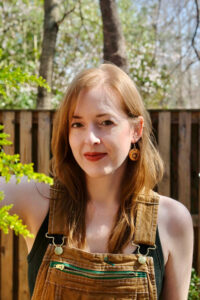
 Today we’d like to introduce you to Sara Cottle.
Hi Sara, thanks for sharing your story with us. To start, maybe you can tell our readers some of your backstories.
Without going too far back, I’ll start with the most pivotal pieces. I’m a born and raised Southern West Virginian who lived abroad and above the Mason-Dixon line in my years after graduating undergrad from West Virginia University. The entire first half of my career was in marketing and advertising for boutique hotels, code and zoning professionals, and robotics companies in New York City. I was doing what I thought I was supposed to do, unfulfillingly. At that time photography, music, and film was a hobby for me and I had been traveling and away from Appalachia so long that I didn’t realize how much of me was suppressed.
It took a couple of life-altering events, very luckily in my early 20s, to put me on the path to my much truer self. In addition to my early professional career in marketing and advertising, my undergraduate degree was a bachelor of science in journalism where I really ended up taking more geology courses than necessary to fulfill the science part of my degree — and fell in love. That detail is important in taking a moment to remember the things you love. I found a great environmental journalism program out in Boulder, Colorado and used this very specific master’s degree to slingshot myself into what I felt a strong sense to pursue.
During my time there I was able to treat all the hobbies I mentioned above as useful skills to my career. The mentors I picked up during my time there (a huge shoutout to Erin Espelie and Michael Kodas) couldn’t have been more balanced and perfect for me. One was a seasoned environmental journalist and the other an environmental filmmaker (among other things), together, they allowed me to exist in this space between journalistic storytelling and film narrative. They also saw — even before myself — how much Appalachia and the South were in my bones. I was also wildly lucky to begin working with Exposure Labs during my time there, which only solidified the fact I could have an impactful career for our planet through the mediums I loved expressing myself most through.
As any Southerner would, I started finding others with those same roots — which led me to Paul Sutter and ultimately Caroline Grego who led me to Richland County in my film. I always preface this part of my story with, yes, the Rocky Mountains are beautiful, and yes Colorado is great, but you ever live somewhere long enough to know that it’s an amazing place to visit, but it just isn’t home? I had a little bit of a track record of this. And after too many months of Colorado winter and drought, someone like me is just looking for excuses to feel the humidity of the east, smell a Carolina coastal breeze, see some friendly faces, hear a drawl, feel the warmth of a region that welcomes others unlike anywhere else in the world. Before ever even embarking on my journey to South Carolina, I was connected to the story — the region.
The South holds so much biodiversity and life and is a region whose stories are often told by outsiders dropping in. It’s a region that is oftentimes exploited — by both industries and storytellers. By the start of this chapter in my life I was very set on knowing that I needed to tell impactful stories from the voices of people I cared about; people I understood. The West is like the posterchild of public lands and recreation — because it’s so new, it’s so vast; the South is full of hidden treasures and has environmental history that is undertold and undervalued. I think of all of the hours spent waking up before dawn to drive to Rocky Mountain National Park and all the full parking lots, whereas Congaree you just show up–you’re in it. National Park designations in the West is a land ownership situation, you have to think about the concept of National Parks; private land ownership is a tenant of Southern existence and it allows for a lot of hidden treasures, as well as concern of industry exploitation and protection of some of the most amazing habitats on Earth.
I can only hope the stories I choose to tell can continue to not only educate around the environment but inspire others to get back to and out in the nature right in their backyards.
We all face challenges, but looking back would you describe it as a relatively smooth road?
I prefer a good muddy path anyways. Being from Appalachia, I’ve always had a chip on my shoulder that I needed to prove myself to the rest of the world — my grammar needed to be perfect, my appearance polished, I should no doubt be as accommodating as possible. It definitely helped me on my journey, as in, my work was always much better than what I always thought.
Film is a tough industry for women, journalism is a tough industry for women. Women voices are often not the first ones heard in a story, and it is women who oftentimes do some of the most kickass work.
Along with some other personal and family struggles — the kind where you realize your parents are not immortal — the most important thing you can have is a great support network. If it weren’t for my brother and parents, best friends, colleagues, and mentors, I wouldn’t have made it as confidently and in the strides that I did.
Can you tell our readers more about what you do and what you think sets you apart from others?
I’d call my work multimedia. I do specialize in film, and even further environmental film.
I’m most proud of my first short documentary ‘Connecting Congaree’, which won an Honorable Mention at the Environmental Film Festival in Washington, D.C.
I guess I’m known for finding those treasures I keep talking about all across the South. I’ve spent more time reading up on the region and mapping in the last 4 years than my entire life. I like a good character and the South is full of friendly people who know someone, who know someone, who can connect you to someone else. They take the time to care and it shows. I take the time to capture that care.
Have you learned any interesting or important lessons due to the Covid-19 Crisis?
I don’t know if it’s interesting or important, but the film industry has certainly adapted. Which might be for the better in the accessible sense.
It’s important to stay connected to your sources as well. When I shared the first cut of my film with all of the community my heart swelled at how appreciative they were, saying “I haven’t been out of my house since COVID and this brought me right back into nature, into my favorite place.”
Film is powerful.
Contact Info:
- Website: www.saracottle.com
- Instagram: www.instagram.com/saraleacottle
- Twitter: www.twitter.com/saracottle
- Youtube: https://www.youtube.com/watch?v=GahLtqwSA2A&t=4s


Image Credits
Sara L. Cottle