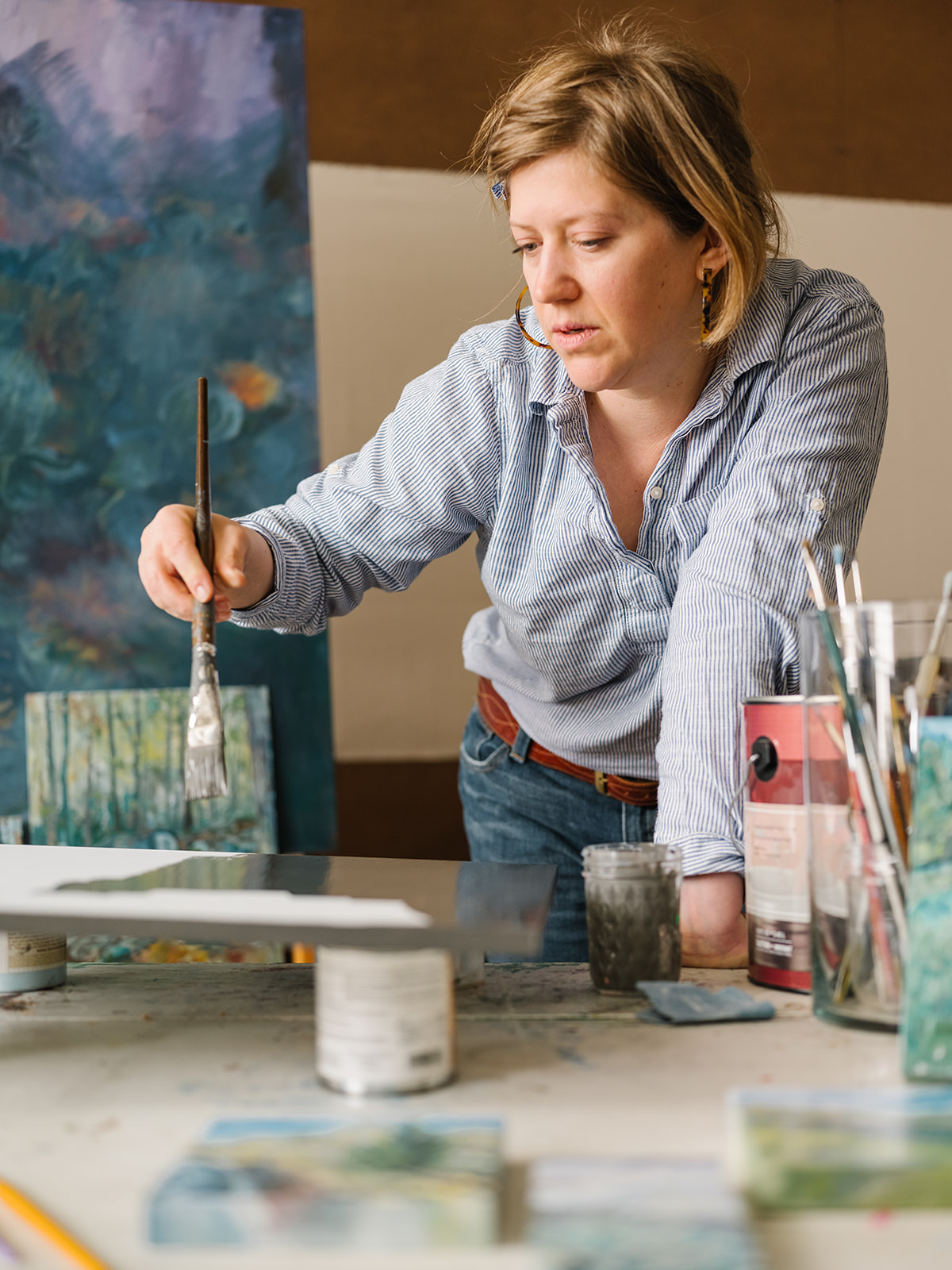

Today we’d like to introduce you to Michelle Berg Radford.
Hi Michelle Berg, so excited to have you on the platform. So before we get into questions about your work-life, maybe you can bring our readers up to speed on your story and how you got to where you are today?
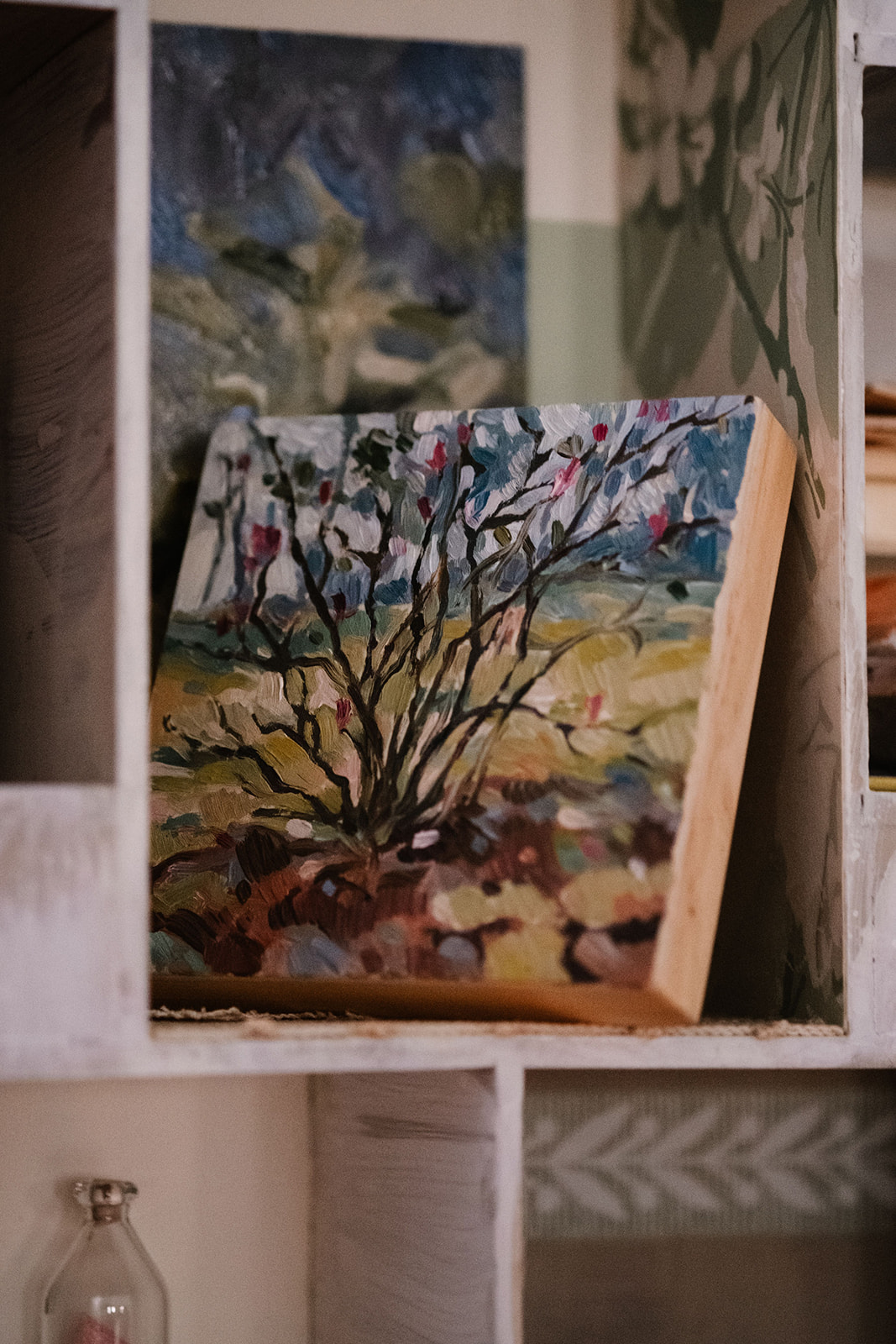
The year I graduated from high school, our family stopped at the Worcester Art Museum, just south of Boston, to allow me to view some art while on a vacation roadtrip. We discovered a notable exhibition of about 75 Hudson River School landscape paintings. The paintings in that exhibition, along with paintings by Winslow Homer and Vincent Van Gogh, which I saw in person about the same time, instilled in me a love for landscape painting.
I studied Studio Art in college with a concentration in 2-Dimensional Art, and enjoyed oil painting the most. I painted landscapes as well as interiors and cityscapes.
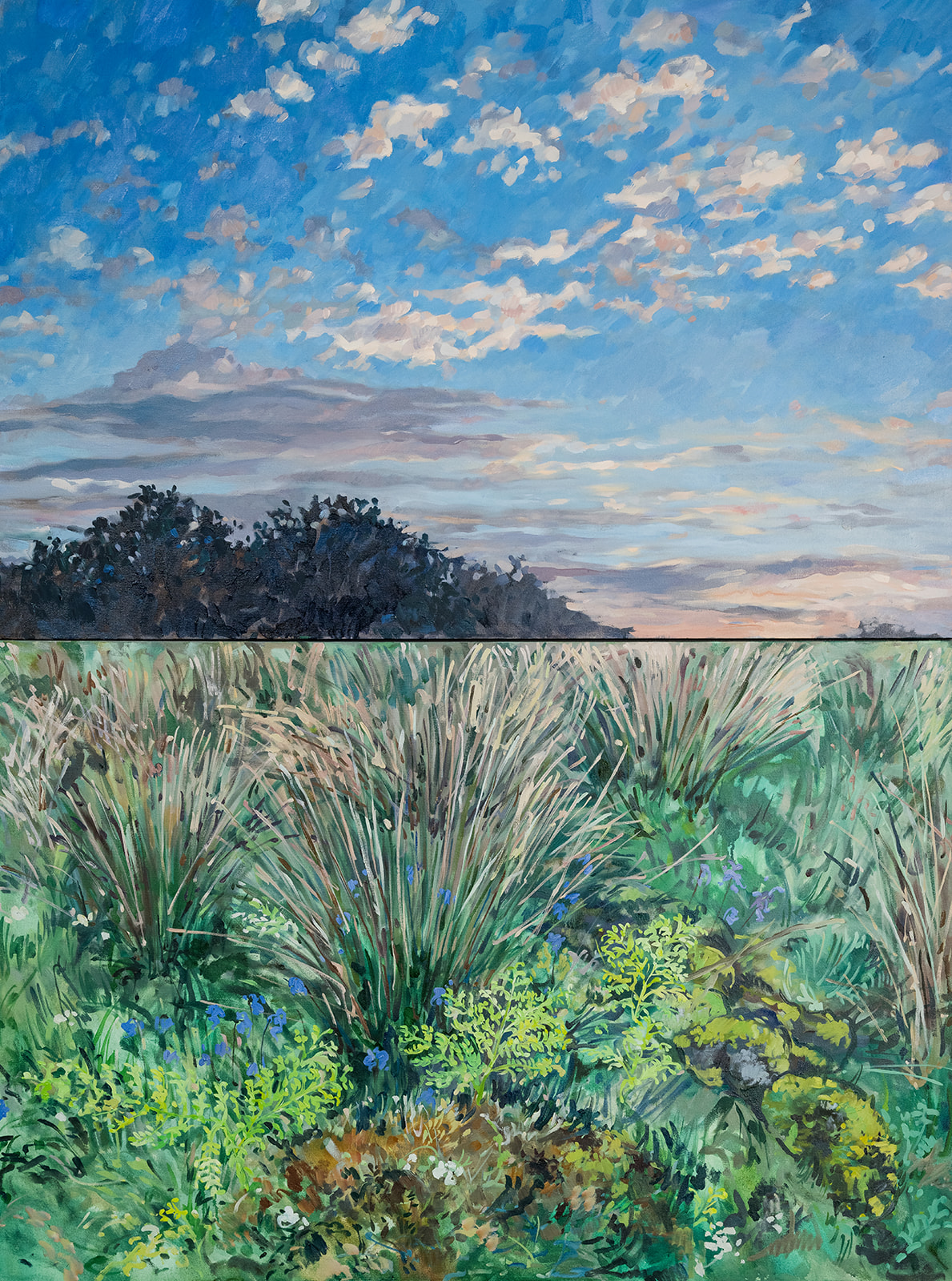
I moved from Greenville to Savannah, GA to study Painting at the Savannah College of Art and Design in their MFA program. It took me a while to adjust to a different topography, different plants, different clouds, since I was painting the views around me. I was lonely and a little scared having moved there all by myself, and would drive out to the coast and spend time looking at the marshes. I eventually fell in love with them and with the new city. I painted the landscape during my two years there, developing a diptych (two panel) format with sky on the top panel and the ground on the bottom panel. It was a new way for me to explore the landscape, but also to talk about the metaphorical meanings of heaven and earth, spirit and matter, the sacred and profane.
I married Paul while I was in school, and we moved back to Greenville after I graduated to take teaching jobs. It was 2008, and we were both happy to have work.
Alright, so let’s dig a little deeper into the story – has it been an easy path overall and if not, what were the challenges you’ve had to overcome?
It hasn’t been a smooth road at all. I thought I might lose my art-making all together.
I continued to paint and teach and even had a solo show while teaching full time in the first year after I graduated from SCAD. I also became pregnant with my oldest during that year. I channeled much of my creative efforts towards preparing for my daughter, but I didn’t imagine that having a child would make art-making more challenging.
Once she was born I tried oil painting, and quickly realized I wouldn’t be able to make art in the same way with a baby. I didn’t obsess over this, probably because I was so tired and busy. Before long I was pregnant again with twins, two boys. I don’t think I made any art during that pregnancy. If I did, I don’t remember. It wasn’t an easy pregnancy, but they were born full-term and healthy. When they were 6 months old, my lack of art-making was really wearing on me. I felt like an imposter teaching painting classes, but not making art myself. I told my husband I needed to make art or I would go crazy, and he agreed it was time for me to set aside some time to make things again. It occurred to me later that I had never before had a period of artistic silence.
I didn’t paint with oils for several years. I thought the landscape painting part of me had died. I really thought I might never do it again. At the time it was hard to imagine ever feeling rested again, ever having more than a half-hour to myself at a time. I had three in diapers and none of my children were good sleepers. They were big, energetic babies that ate constantly. I loved them, but I was exhausted.
I had always made art, so I was surprised by how difficult those months away from the studio were. I think many people benefit from the way art grounds them and keeps the even-keeled and alive to the world around them. I hadn’t realized how vital it is for me. But I also had an enormous amount of guilt about leaving my babies to go make art, even if it was only for a half hour at a time. There wasn’t much talk back then about being an artist and a mother. There wasn’t much writing about it either. But I am thankful for all I learned during that difficult time of trying to sort out questions of identity, caregiving, motherhood, and what art is for.
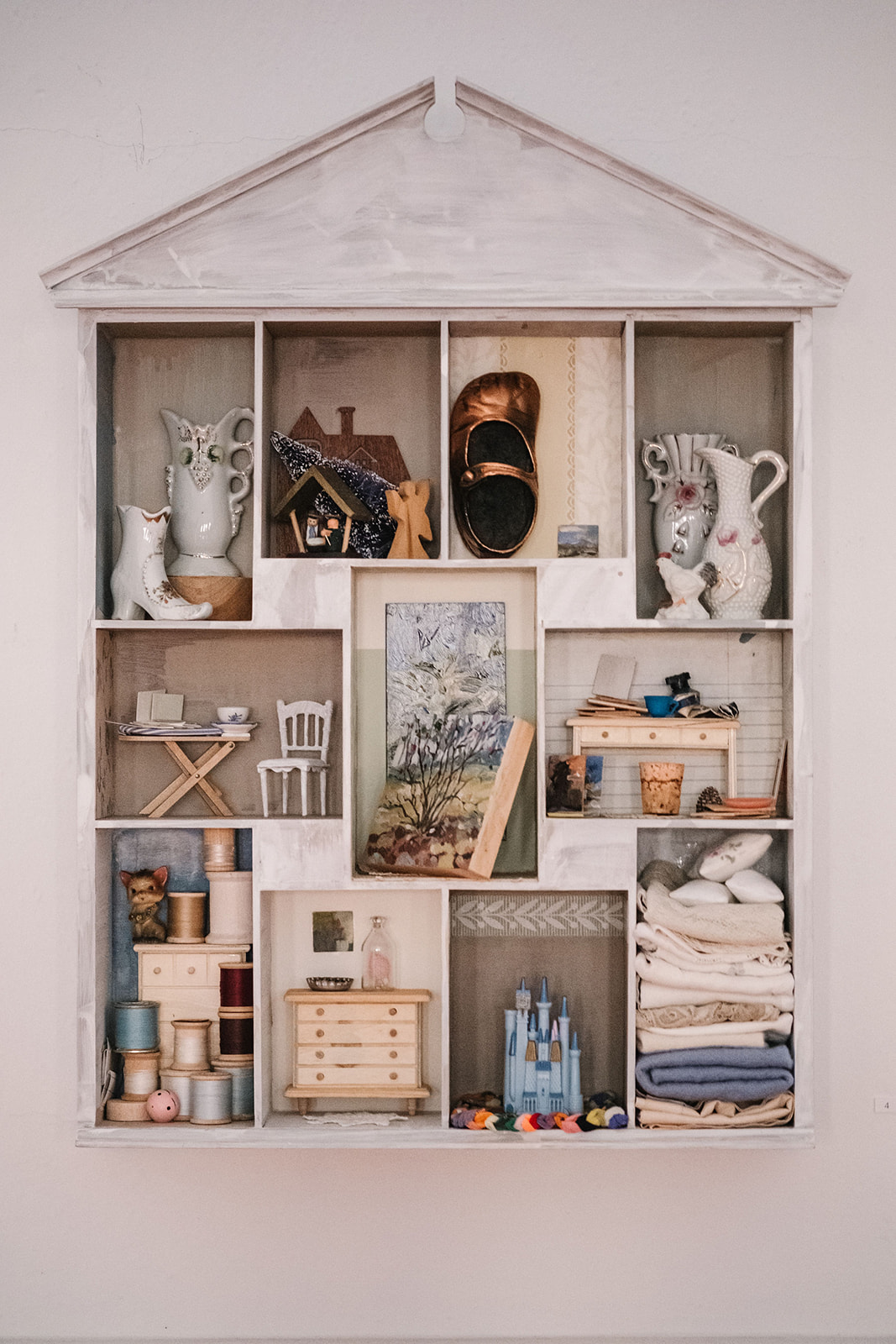
So I did return to the studio, but instead of painting landscapes I made collage/assemblage pieces with vintage textiles and dollhouse furniture, tiny things I had collected. I started making art about what my life was then–not expansive outdoor vistas, but domestic repetitions, tiny vignettes of indoor life.
I believe that art, like mothering, is a form of care. I also believe that I’m called by God to do both. So there’s actually a unity in those two vocations, rather than a division. At one time they seemed to be at odds with one another, but over the years, through purposeful practice and the help of my husband and community, I’ve woven them together. The beginning of that weaving them together was by making my art about motherhood and domesticity.
Appreciate you sharing that. What else should we know about what you do?
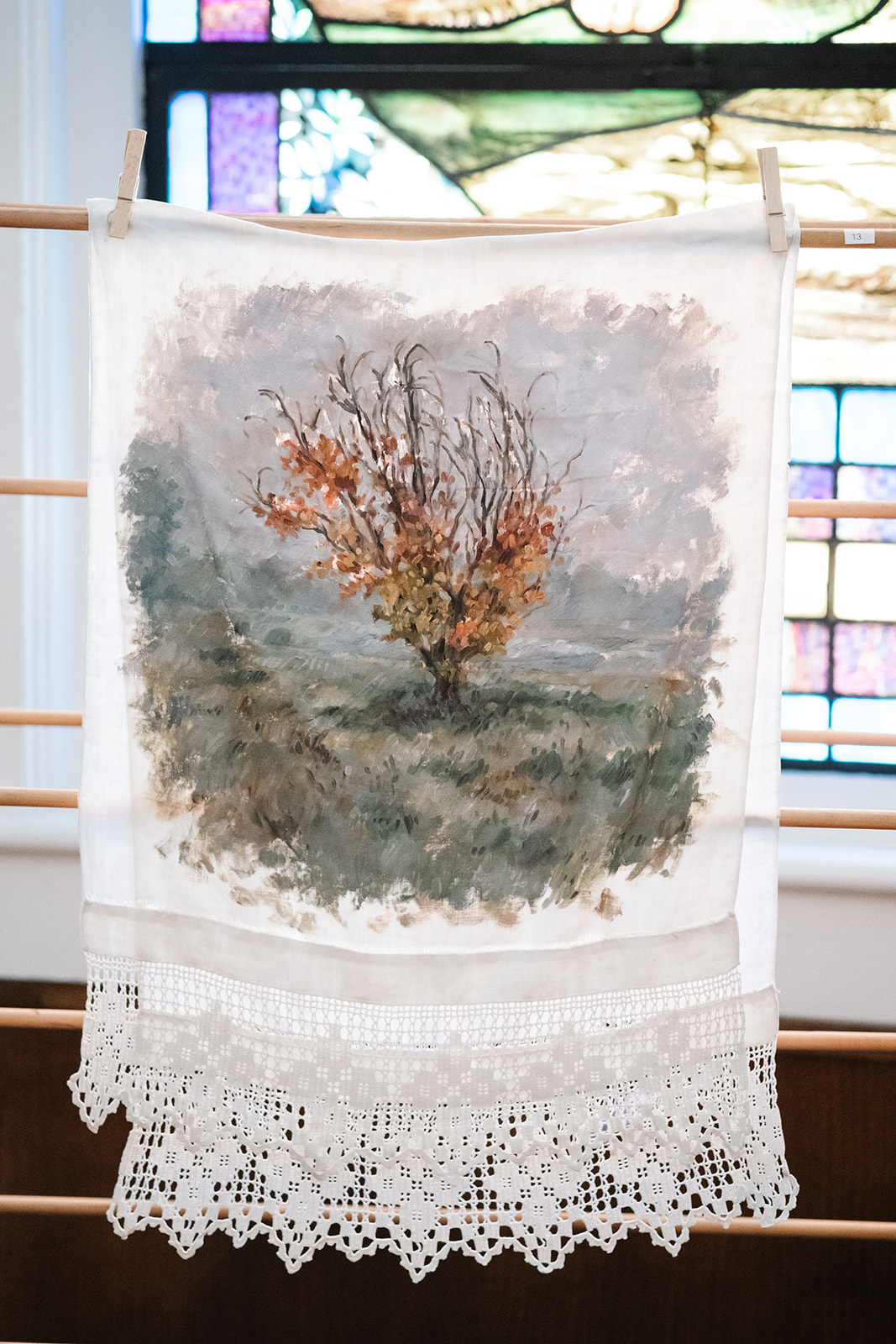
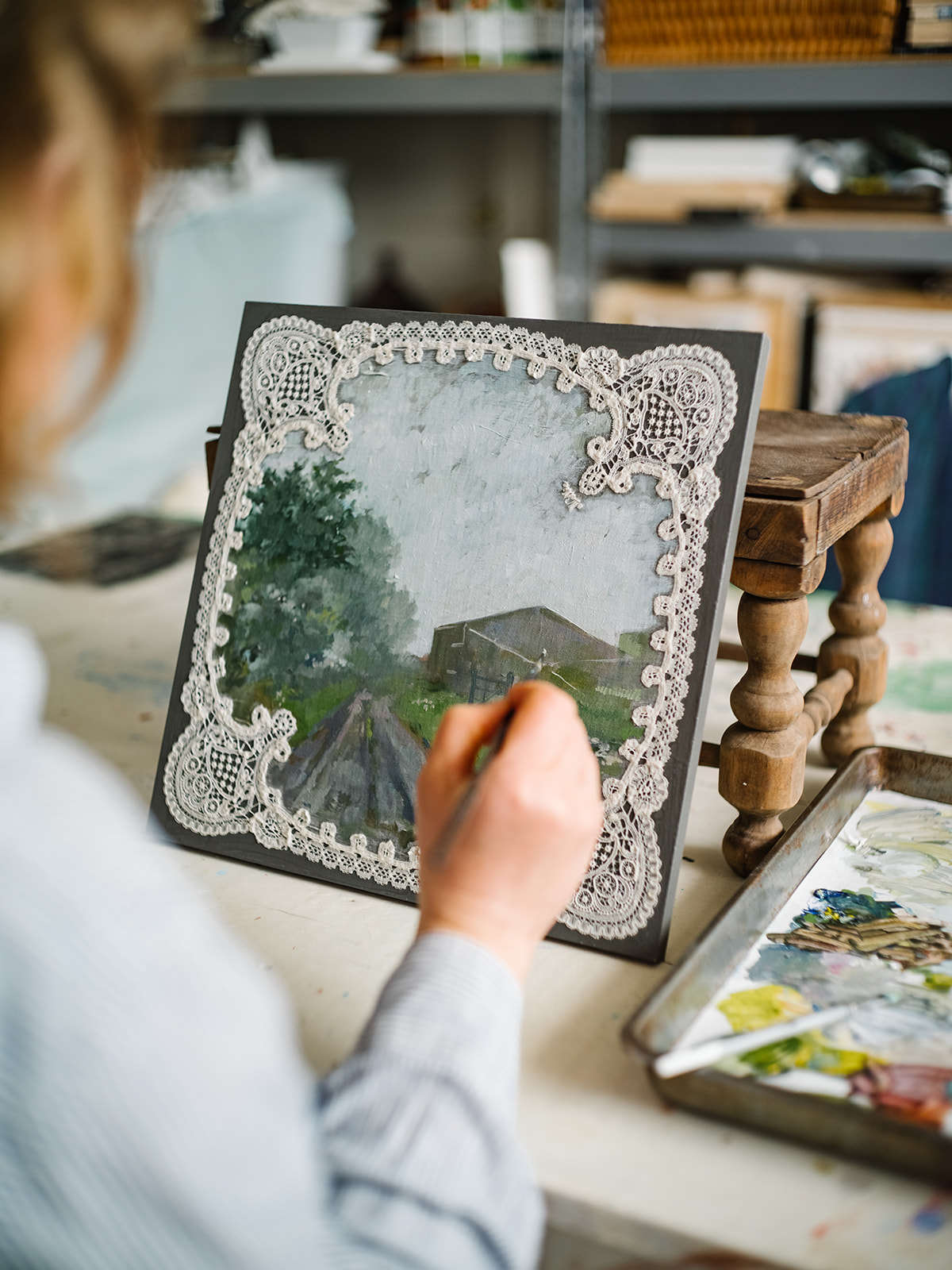
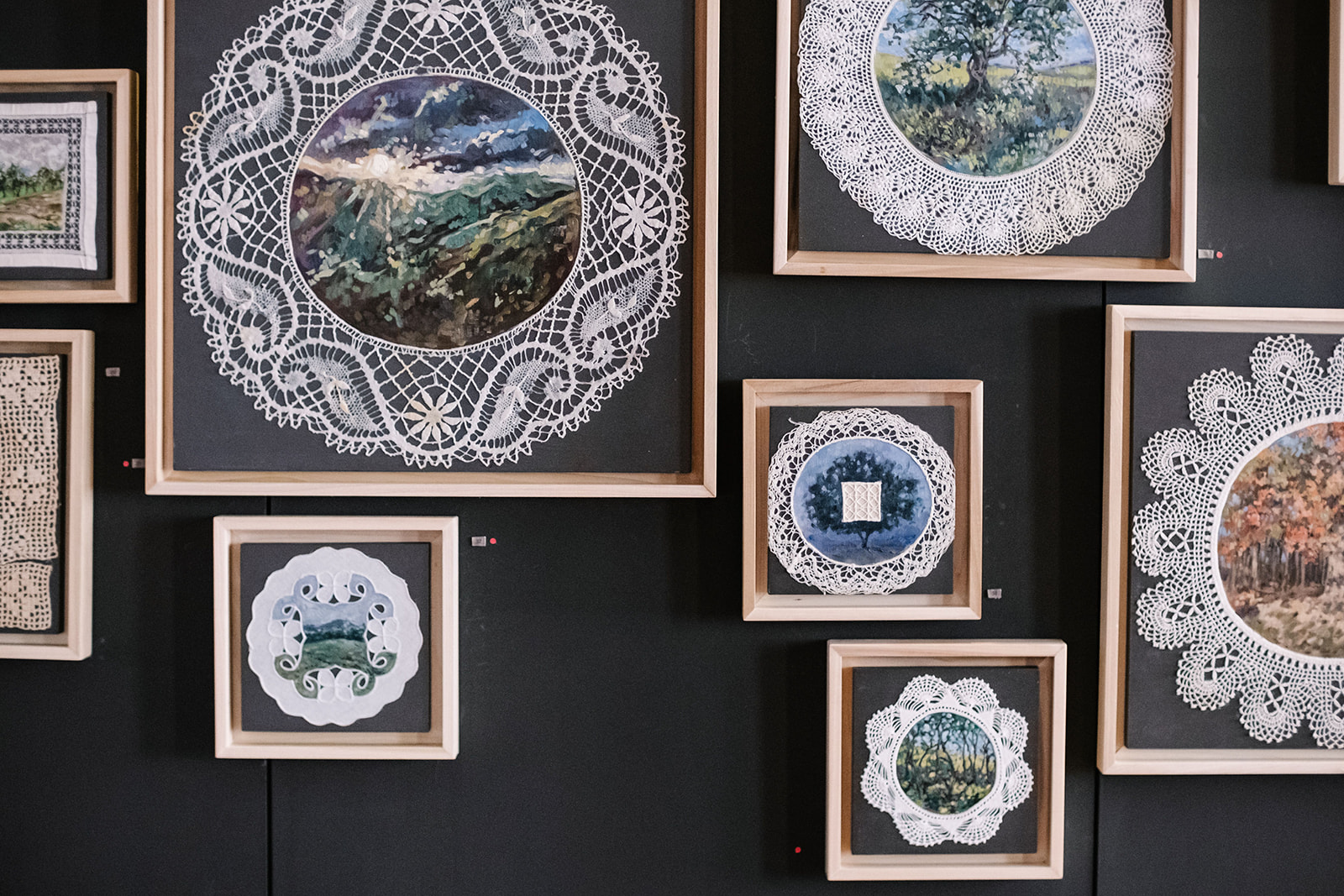
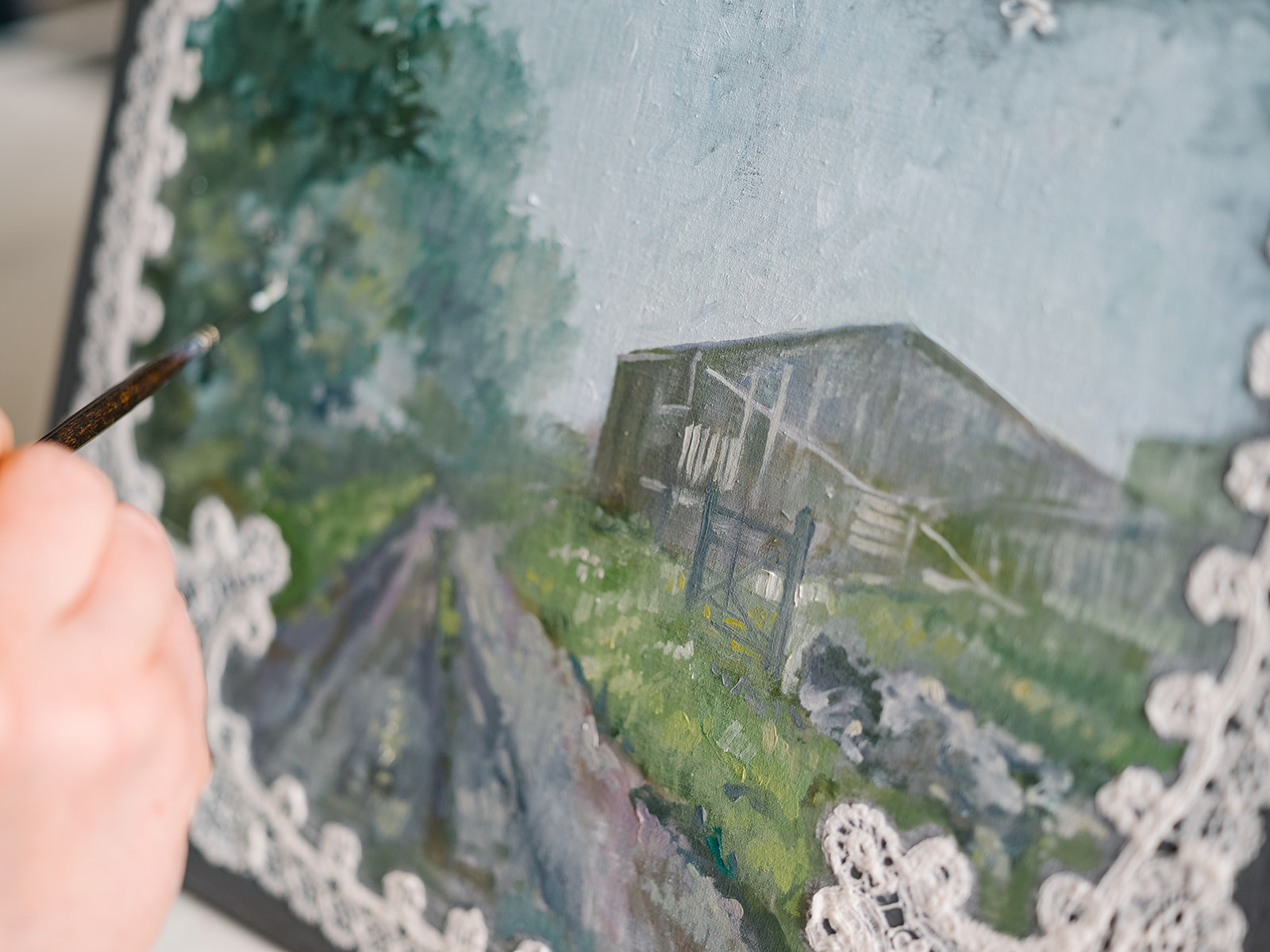
The work I make now weaves together my love for traditional landscape painting with my love for textiles and textile processes. Combining these two kinds of making allows me a metaphor to talk about the way I have worked towards weaving together my role as a professional painter and my role as a mother. I’m always looking for ways to combine landscape painting with textile processes. I paint landscapes on doilies, I paint on canvas then fold and smock the paintings, I cut up paintings and piece them together like a quilt. I think it’s important to me to keep speaking about the combination of art-making and motherhood. Each enriches the other in my life.
When I was first making art with vintage doilies and fabrics, one of my friends pointed out to me the repetition inherent in textiles processes. A doily might be crocheted in a series of repetitive knots. A fabric is woven in a pattern of over-under-over-under repetition. Sewing is the up-down-up-down of the needle. All of these textile processes are repetitive at their core. She pointed out to me that much of my daily life with children in the home is repetitive: dishes, diapers, feedings, naps. At the time I was having a hard time seeing the beauty in all that domestic repetition, but seeing the parallels between domestic tasks and textiles gave me new metaphors for my art, and helped me to see the invisible beauty in my daily life.
Let’s talk about our city – what do you love? What do you not love?
I was born in Greenville and have lived here my entire life except when I was away for school. I love that we are a few minutes from the mountains but also have such a beautiful downtown. We are lucky to have so many residents that appreciate the arts.
I am always sad when I see more trees being cut down for “development.” I am concerned that Greenville is getting less green every day as trees and wildlife are crowded out by parking lots and not-so-beautiful construction.
Contact Info:
- Website: https://www.michellebergradford.com
- Instagram: @michelle.radford