
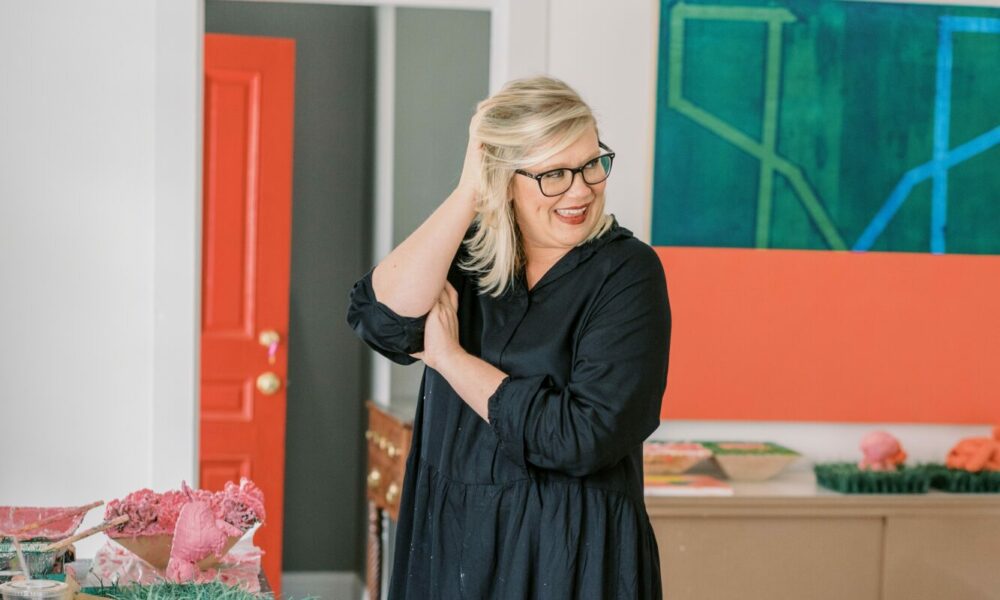
Today we’d like to introduce you to Liz Rundorff Smith.
Alright, so thank you so much for sharing your story and insight with our readers. To kick things off, can you tell us a bit about how you got started?
I landed in Greenville, SC in 2006, just after completing an MFA in painting from Edinboro University of Pennsylvania, to work as Visual Artist Manager for the new Artisphere outdoor art festival. Over the next ten years, I worked hard to help create a successful festival while painting in a studio in my home on evenings and weekends. In that time, I also got married, built a new home, and had two baby girls 15 months apart – so painting time got more and more difficult to find. In 2016 I joined the staff of Greenville Center for Creative Arts as Program Director with the goal of finding more time in the studio while continuing to work in the arts. Today I am able to balance my time working in art administration with time in the studio. Time has become my greatest resource and, because my time is limited, I have become incredibly driven in recent years to make as much work as possible with the limited resources I have. I have learned to work in small segments of time – sometimes that means working on small acrylic paintings on paper at my kitchen table, or working on multiple paintings in varying sizes in the studio so that I can add a little to each piece in short painting sessions – I’ve built the practice into my life rather than waiting for my life to change to give me more time. The discipline of working on something every day has been challenging but also so important in my personal growth.
Would you say it’s been a smooth road, and if not, what are some of the biggest challenges you’ve faced along the way?
Making work has not been an issue for me. I don’t tend to wait for inspiration. I am always working on something even if it’s just drawings and sketches when I don’t have the time and resources to make work. I have found it difficult to define the work I really want to make and to work consistently on one body of work without losing interest and direction. Even today I have ten different ideas I want to work on! I guess I realized at some point in my career that nobody was coming for me. Meaning that if I really wanted to get my work out and pursue a career as an artist, I had to do the work of finding my audience and creating my success. That can be exhausting when you’re also working to find time just to make the work but I have become much more self-directed by changing my mindset from one of waiting for opportunity to find me to making opportunity for myself. Artists are often strapped for resources but I think really interesting work can come from limitations. No one is ever going to tell me that I need to spend more time in the studio so making time in the studio a priority has been a really important part of my growth as an artist.
Can you tell our readers more about what you do and what you think sets you apart from others?
I am a contemporary visual artist working in multiple painting mediums – encaustic, oil, acrylic, and gouache. Some of my encaustic work borders on sculptural but most pieces are wall hanging and can still be considered paintings. My work can be described as bold, bright, iconic abstraction. I use color to evoke a sense of nostalgia, working predominantly with a palette that is reminiscent of the design trends of decades past. I work with reductive, simple forms that reference the history of minimalism. I like to think that I am taking the formal structure of minimalism and making it messy with sentimentality and personal meaning.
Is there any advice you’d like to share with our readers who might just be starting out?
Just keep working! Artists commit to a lifelong pursuit so find a way of working that you can sustain. You may not always have the money for the supplies you really want or the space to make work in the scale you envision but you will get there if you keep working. An artist’s greatest asset is the ability to be a creative problem solver so work within the limitations to find a creative solution. Also, learn to be your own best judge. You’re going to get a lot of feedback and not all of it will be good so learn to trust your own opinion.
Contact Info:
- Email: lizrundorffsmith@icloud.com
- Website: https://www.lizrundorffsmith.com/
- Instagram: https://www.instagram.com/lizrundorffsmithstudio/
- Facebook: https://www.facebook.com/lizrundorffsmithstudio/


Image Credits
Melissa Brewer Photography
Eli Warren Photography
Tara Ashton